Before the Recipe Book: How Cooking Knowledge Was Passed On
Learn how cooking knowledge traveled through demonstration and memory, and how to record a family method with clear steps, quantities, and sensory cues.
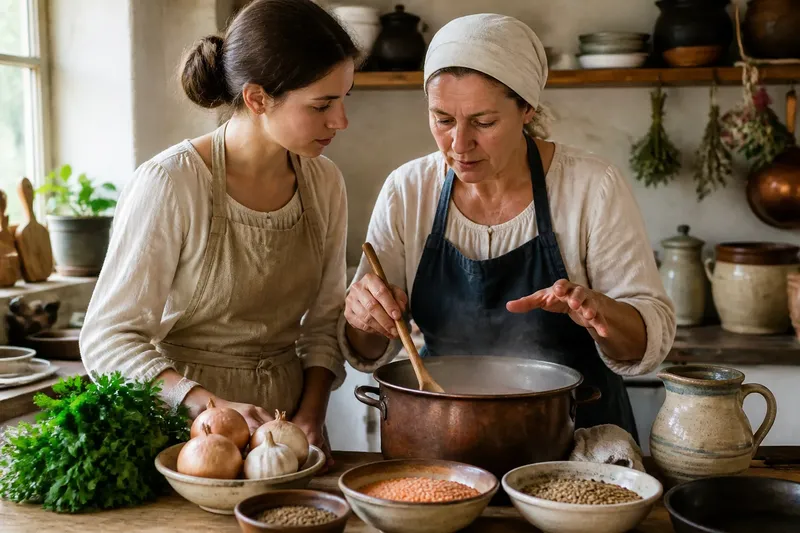
How did cooks pass on a method before a recipe book was at hand? Cooking knowledge often traveled through demonstration, memory, spoken instruction, and writing, though the mix varied across households and periods. A learner might watch someone stir porridge, then be asked to judge when the grains had softened.
Cooking lessons connected words to visible changes
In many household settings, instruction took place while a meal was being prepared. A teacher could ask a learner to rinse rice until the water looked clearer, stir a pot before food stuck, or add flour until dough stopped clinging to the bowl.
These directions linked an action to a cue. The learner had to notice how the ingredient changed, not just remember a list of commands. A teacher might point out a dough that felt stiff, a simmer that had become too vigorous, or fruit that smelled ready to cook.
Demonstration could also account for differences in ingredients and equipment. Flour might feel dry or damp, an onion might be larger or smaller, and a heavy-bottomed pot could heat differently from a thin one. An experienced cook could show how to respond to the conditions in front of them.
Remembered proportions depended on shared context
Instructions such as “a handful,” “enough to bind,” or “until it smells done” could be useful when teacher and learner shared a bowl, ingredients, and an idea of the intended dish. These phrases conveyed practical judgment without specifying a standard quantity.
A cook might remember a relationship between ingredients, such as a measure of grain to a vessel of water, or add flour until batter reached a familiar consistency. The exact amount could change with the batch and the cook’s purpose.
Memory had limits. A learner who missed a demonstration might remember which ingredients went into a dish but forget their order, or recall “a little” without knowing what the cook meant. As a method moved to a new kitchen, its cues and assumptions could be harder to carry along.
Writing kept a method available beyond its teacher
A written recipe could be consulted when the person who taught the dish was absent, or revisited after a long interval. It could preserve a named dish and the order of its actions, especially when the method involved more stages than a learner could easily retain.
Writing did not remove the need for interpretation. “Cook until tender” still asks the reader to judge tenderness, while “moderate heat” may be understood differently according to the stove and the cook’s habits. A page can keep a method in view without showing every movement or sensory cue.
Nor did every written recipe aim to explain itself to an unfamiliar reader. Some were intended for people who already knew the ingredients, tools, or conventions. That context helps explain why a record might preserve a sequence yet leave out details that a modern reader needs.
Written recipes made repetition more portable
A recorded sequence gave cooks a prompt they could consult without relying on a single remembered lesson. Someone could follow the order, compare the result with the directions, and adjust a later attempt. The method could travel beyond its original kitchen, though the reader might not share the writer’s equipment or experience.
Demonstration conveys timing through movement and context: how quickly to stir, what a pot sounds like, or when a mixture has changed enough. A recipe has to translate such observations into words, and readers may interpret those words differently.
A written version can also make one household’s familiar method look more fixed than it was in practice. The original cook may have accepted substitutions or small adjustments without mentioning them. A record is useful evidence of one version, not necessarily a rule that excludes every other version.
How can you preserve the parts a page cannot show?
Why might a recipe omit exact quantities?
The intended readers may already have known the ingredients, tools, and customary measures. A brief direction could be clear within one cooking community while remaining vague to someone outside it.
Can a written recipe replace watching a cook?
A recipe can preserve the order of actions and provide a prompt, but it may not show texture, timing, or how to respond to a change. Watching someone cook can supply those details, while a written note helps preserve them for later.
Why can older recipes be hard to follow?
They may assume equipment, ingredient names, and kitchen habits that a reader does not share. They can also leave out steps that seemed obvious to their original audience.
What should you write down when recording a family method?
Record the sequence, the quantities used in that particular preparation, and the sensory signs that guide decisions. If the cook adjusts an ingredient, note what prompted the change as well as the resulting texture or appearance.
Record quantities alongside sensory cues
A useful recipe identifies the moments when a cook must decide what to do next: when to stop adding liquid, how to recognize a gentle simmer, or what texture means dough is ready to rest. Those cues help another cook adapt without treating a quantity as universal.
Say you are writing down a relative’s lentil soup, and the starting instruction is “add broth until it looks right.” As the soup is made, you record the order of ingredients and the amount of broth used in that particular pot. You also note the observable result the cook wants: softened lentils and broth loose enough to ladle. A later cook can compare the soup with that description and add broth if it is too thick, rather than assuming the recorded amount must fit every pot.
- If the cook names a measured quantity, record the ingredient and amount; if the amount changes with the batch, mark it as a starting point and describe the adjustment cue.
- If the cook uses a household measure such as a cup or bowl, identify that vessel; if its size is unknown, describe the fill level rather than presenting it as a standard measure.
- If the cook changes the ingredient order, write down the order used; if the order varies, note which visible condition prompts the change.
- If texture signals the next action, describe what it looks or feels like; if the cue is hard to name, ask the cook to point it out during preparation.
- If heat is described with a word such as “low” or “gentle,” record the stove setting and the visible or audible sign; if the sign differs on another stove, tell the reader to judge the food rather than rely on the setting alone.
- If the cook makes a substitution, record what changed and how the finished dish differed; if the result is not the intended one, keep the original ingredient as the reference version.
It is not worth the effort to record every motion in exhaustive detail. Focus on the points where timing, texture, or an easily forgotten choice changes the result; routine actions need less space.
Teaching and writing preserve different parts of a method
Cooking knowledge did not shift in one uniform move from speech to print. Demonstration could show what a page described only imperfectly, while written recipes kept sequences available between lessons. In a kitchen that used both, a learner could watch, practice, and consult a note later.
When you record a recipe, treat it as an account of a practice rather than a command. Preserve the actions another cook can repeat, along with the signs that help them respond when ingredients behave differently. That makes cooking knowledge passed on through memory and demonstration easier to teach again, without pretending that one written version captures every kitchen’s way of working.